

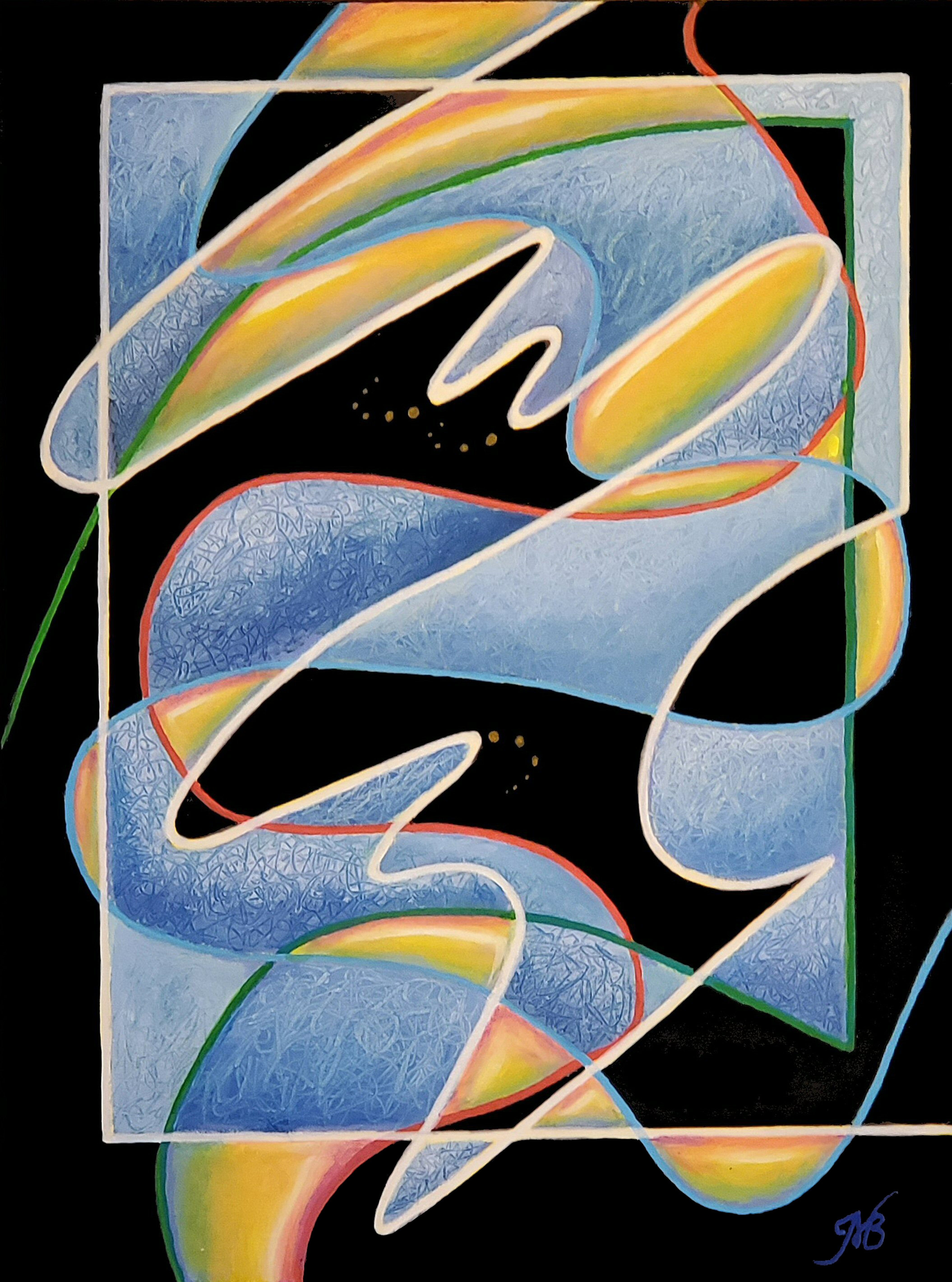
“Dawning” Oil & Acrylic on Canvas, 18 x 24
Art is often treated as a luxury — something beautiful, optional, and secondary to the “real” business of life. We speak of it as enrichment, decoration, entertainment, or cultural refinement. But neuroscience tells a different story. When human beings engage with art, the brain comes alive in ways that are not optional at all. Art activates the networks that make us fully human: imagination, meaning, emotion, empathy, and the sense of self. Far from being a luxury, art is one of the oldest survival tools our species ever developed. It is a necessity we have forgotten how to name.
The Brain on Art: What Science Now Knows
Over the past two decades, neuroscientists have studied how the brain responds to drawing, painting, music, calligraphy, and aesthetic experience. Their findings are remarkably consistent.
Art activates the brain’s core networks
When we engage with art — whether creating or viewing — the brain’s major systems light up:
The default mode network, responsible for imagination, inner reflection, and the construction of meaning.
The salience network, which determines what matters and why.
The reward system, releasing dopamine and supporting motivation, curiosity, and pleasure.
Sensory integration pathways that unify perception into coherent experience.
This is not passive consumption. It is whole‑brain engagement. Art recruits the very systems that allow us to interpret reality, understand ourselves, and navigate the world.
Art regulates emotion and reduces stress
Research consistently shows that:
Viewing art lowers cortisol.
Making art increases parasympathetic calm.
Creative activity improves emotional resilience.
Even brief artistic engagement can shift mood and stabilize the nervous system.
Hospitals, trauma centers, and aging programs now integrate art therapy because it reliably helps people recover, adapt, and heal.
Art strengthens cognitive flexibility
Drawing, improvisation, calligraphy, and symbolic exploration all increase cognitive flexibility — the ability to shift perspectives, solve problems, and adapt to change. Neuroscientists consider cognitive flexibility one of the strongest predictors of long‑term mental health.
Art trains the mind to move, to imagine alternatives, to see beyond the obvious. It keeps perception alive.
Art deepens empathy and social connection
Researchers such as Semir Zeki and Anjan Chatterjee have emphasized that art:
builds empathy
strengthens social bonds
creates shared meaning
reduces loneliness
expands our capacity to understand others
Humans evolved as meaning‑making creatures. Art is one of the oldest tools for meaning.
Art as a Biological Necessity
Anthropologists and neuroscientists agree on a striking fact: art predates agriculture, writing, and cities. It appears in every culture, without exception. If art were optional, evolution would have eliminated it. Instead, it flourished.
Why?
Because art:
regulates emotion
encodes knowledge
strengthens group identity
supports imagination
anchors ritual
shapes consciousness
expands perception
connects individuals to something larger than themselves
Art is not an accessory to human life. It is woven into the architecture of the human brain.
The Imaginal Dimension: Reality Beyond the Senses
This is where the scientific story meets the transcendental one.
Art does not merely represent the visible world. It reveals the invisible one — the imaginal, symbolic, perceptual dimension that lies beneath sensory experience. Gesture carries meaning that cannot be spoken. Symbolic marks reveal inner realities. Images arise from the deeper layers of perception, not from decoration.
Art is a bridge between the sensory world and the unseen dimensions of experience. It gives form to what cannot be grasped directly: intuition, imagination, inner movement, the subtle architecture of thought and feeling.
Neuroscience supports this indirectly. The networks activated by art are the same networks involved in:
constructing the self
imagining possibilities
forming beliefs
interpreting meaning
sensing the presence of what cannot be seen
Art is not merely expressive. It is perceptual. It reveals how the mind touches reality beyond the senses.
Why We Can’t Live Without Art
When we remove art from life, the consequences are subtle but profound:
The brain becomes narrower.
Emotion becomes dysregulated.
Imagination collapses.
Meaning thins out.
Empathy declines.
Society loses coherence.
Art is how humans stay human.
It is how we remember who we are, how we connect to one another, and how we perceive the deeper layers of reality. It is how we heal, how we imagine, how we understand, and how we grow.
Art may look like a luxury. But it is not.
It is a necessity — biological, cognitive, emotional, social, and spiritual.
It is the one luxury we cannot live without.