

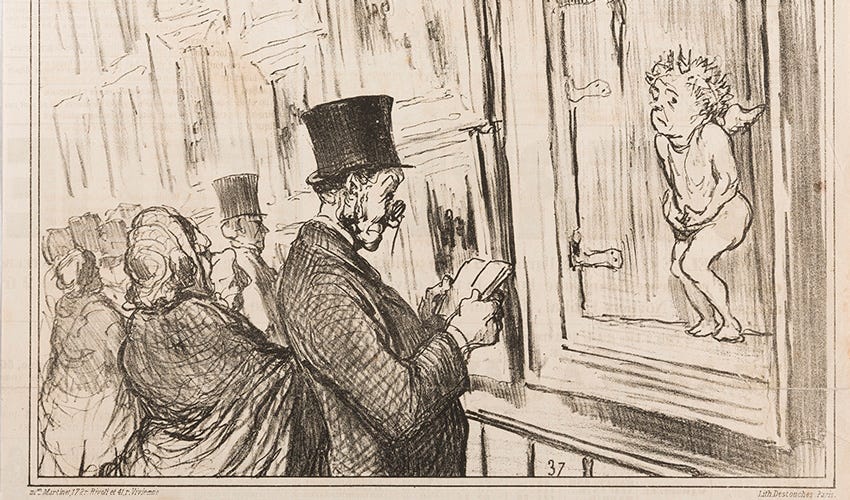
This week I spent time observing people as they moved through an art exhibit.
Most spent only a few seconds in front of each piece.
Pause. Glance. Move on.
Pause. Glance. Move on.
Watching them, I was reminded of people browsing a flea market. They scan tables filled with objects, hoping something will immediately catch their eye. If it does not, they continue walking.
Many people approach art the same way.
The experience made me wonder whether the problem is not a lack of interest in art at all. Perhaps the problem is speed.
Art often whispers.
We have trained ourselves to listen only to things that shout.
A painting occupies a strange place in our culture. Unlike a film, it does not unfold over time. Unlike a book, it does not tell us how long it will take to experience it. It simply hangs on the wall and waits.
The painting says:
“Slow down.”
“Take your time.”
“I’m not going anywhere.”
Yet many viewers never remain long enough for the conversation to begin.
What’s interesting is that art knowledge does not always help.
In fact, it can sometimes get in the way.
This may sound odd coming from an artist who has spent a lifetime studying art history and technique.
Knowledge is valuable. It deepens appreciation. It reveals connections and influences.
But knowledge has a danger.
It can replace seeing.
Instead of experiencing a painting, we classify it.
Impressionist.
Abstract.
Expressionist.
Contemporary.
Derivative.
Influenced by this artist.
Related to that movement.
The painting becomes a specimen rather than an encounter.
I have often noticed that some of the strongest responses to my own work come from people with little formal art training.
One comment appears again and again:
“I don’t usually like abstract art, but I like yours.”
At first I found this puzzling.
Now I think I understand.
Such viewers are not responding to a category. They are responding to an experience.
They stand in front of a painting and ask a simple question:
“What does this do to me?”
That may be the purest question in all of art.
A maintenance worker who recently helped hang one of my exhibits expressed exactly this kind of response. He was not approaching the paintings as an art critic. He spent time with them because his job required it. He carried them, positioned them, stepped back, adjusted them, and looked at them again.
In a sense, he lived with the paintings before judging them.
Many gallery visitors spend less time with a work than it takes to read the label beside it.
This raises another question.
What if great art is not something we understand?
What if great art is something we gradually enter?
Think of a foggy landscape at dawn.
At first, very little is visible.
Then details emerge.
A tree.
A field.
A distant hill.
The landscape has not changed. Our relationship to it has changed.
The same thing happens with art.
An image that seems simple on first viewing may become increasingly rich as we remain with it.
The painting reveals itself in layers.
Leonardo understood this. So did Vermeer. So did countless artists whose work is less about making an immediate impression and more about sustaining attention.
Perhaps that is why I have always preferred soft edges and atmosphere to sharp boundaries.
The world itself is not made of outlines.
Things emerge gradually from light, shadow, memory, and perception.
The longer we look, the more we see.
And perhaps that is the quiet lesson art continues to offer in an age of relentless distraction:
Slow down.
Take your time.
Stay a little longer.
The painting has been waiting for you all along.