



Life Is Like a Flowing River
Just as a river never stands still, life is always in motion. We’re carried forward by time, experience, and change—sometimes gently, sometimes with rapids.
We begin at a source.
Every river has a spring, a beginning. So do we—born from something greater, shaped by origins we may not fully see. The source nourishes us, even when we drift far downstream.We carve a path.
Rivers shape the land they touch. Likewise, our lives leave impressions—on people, places, and moments. We don’t just pass through the world; we sculpt it.We receive and give.
A river is fed by tributaries and rain, and it gives water to fields, forests, and cities. Life flows best when we’re open to receiving and generous in giving—whether love, time, or presence.We encounter obstacles.
Rocks, bends, dams—rivers adapt. They find new paths or wear down resistance over time. Life asks the same of us: to meet difficulty not with rigidity, but with flow.We are part of something larger.
No stream exists alone. It joins others, becomes a river, and eventually merges with the sea. Our lives, too, are part of a greater whole—interwoven with others, returning to the Source.
This metaphor isn’t just poetic—it’s practical. It invites us to live with rhythm, openness, and trust in the current.
The Bible often uses rivers to symbolize life, renewal, abundance, and divine presence. These aren’t just poetic flourishes—they’re deeply spiritual metaphors for life.
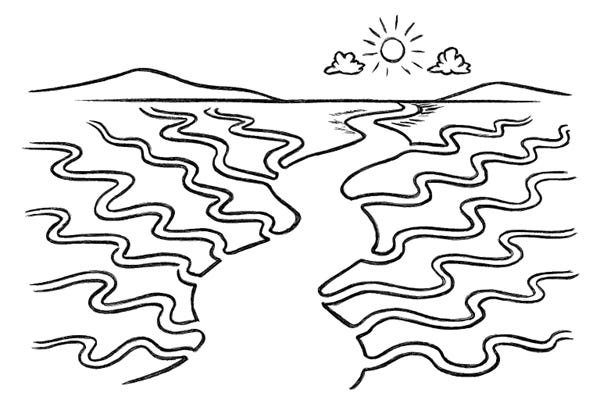
In the image of a river we are each a stream feeding the larger river—distinct, alive, and moving—yet inseparable from the waters that nourish and carry us.
When we recognize this, when we flow with the current and offer ourselves to the whole, we find joy as we come into rhythm with our true being.
But when we resist—when we dam ourselves off or forget the source—we feel dry, disconnected. We suffer not because we lack, but because we’ve stepped out of the stream.
This is the mystery the Bible calls eternal life—not a distant reward, but a present reality. A life that flows from the Source and returns to it, again and again -- a life of giving and receiving, of unity and multiplicity, of presence and participation.
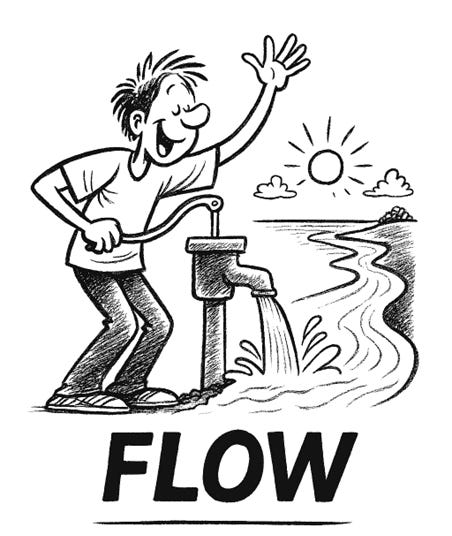
The illustration of the smiling figure pumping water into a winding stream shows this beautifully. It’s not just effort—it’s harmony. The stream flows because the person partici-pates. And in that participation, joy arises.
But not all giving flows freely.
In the paired emblems that follow, we see two contrasting spirits:
One character gives joyfully—eyes bright, posture open—and receives even more in return.
The other gives reluctantly—brow furrowed, hand clenched—and receives less.

Giving Begrudgingly and Giving Joyfully
“The spirit you give with shapes what flows back.”
Two hands reach outward—one clenched, one open.
One gives with joy, and the stream multiplies. One gives with fear, and the stream thins. The river responds not only to the gift, but to the heart that sends it.
And yet, generosity often feels illogical. Our instinct is to hold tight, to preserve, to protect. We fear that giving means losing— that what leaves our hands leaves our lives.
But this is the illusion of scarcity.
In truth, giving opens the channel. It is not subtraction—it is circulation. Like a stream that flows into the river, what we offer returns, multiplied and transformed.

Clinging tightly to our possessions—whether money, time, or self—can blind us to the abundance already shining around us.
Hold a penny to your eye, and the sun disappears. So too with our giving— clutch too tightly to our possessions, and the divine flow of giving and receiving fades.
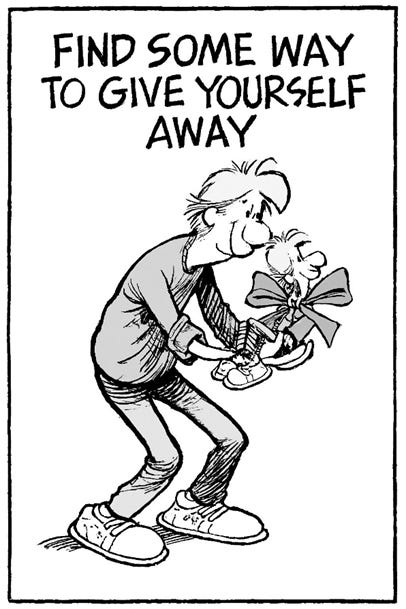
The chapters that follow will offer ways to give yourself away— not as loss, but as participation. Not as sacrifice, but as flow.
There’s an illustration in the Christian text about a poor widow who quietly places two small coins into the temple treasury. Others around her give large, impressive sums, but she gives everything she has. Not out of obligation, but out of trust. Her gesture is small, almost invisible—but it’s full of heart. The story suggests that her gift, though tiny, carries more weight than all the rest. Why? Because it flows from a spirit of joyful surrender.
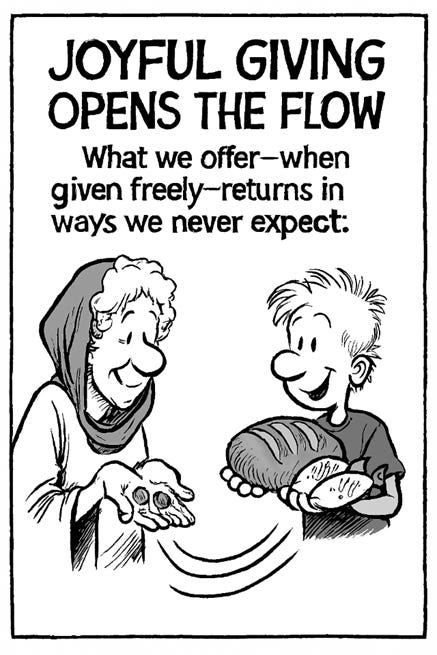
Another story tells of a young boy in a crowd of thousands. He’s carrying a simple lunch—just a few small loaves of bread and a couple of fish. When the crowd grows hungry, he offers his meal. It’s not much, but it’s what he has. And somehow, that modest gift becomes enough to feed everyone. The food multiplies, and baskets of leftovers remain. It’s a moment of miraculous abundance, sparked by a child’s willingness to share.
Both stories remind us: it’s not the size of the gift that matters. It’s the spirit behind it. Joyful giving opens the flow. It invites transformation. It turns scarcity into celebration.
(Next Week: Part 2 — Words of Encouragement: A Generous Flow)
Also, my new book is free all this month.