


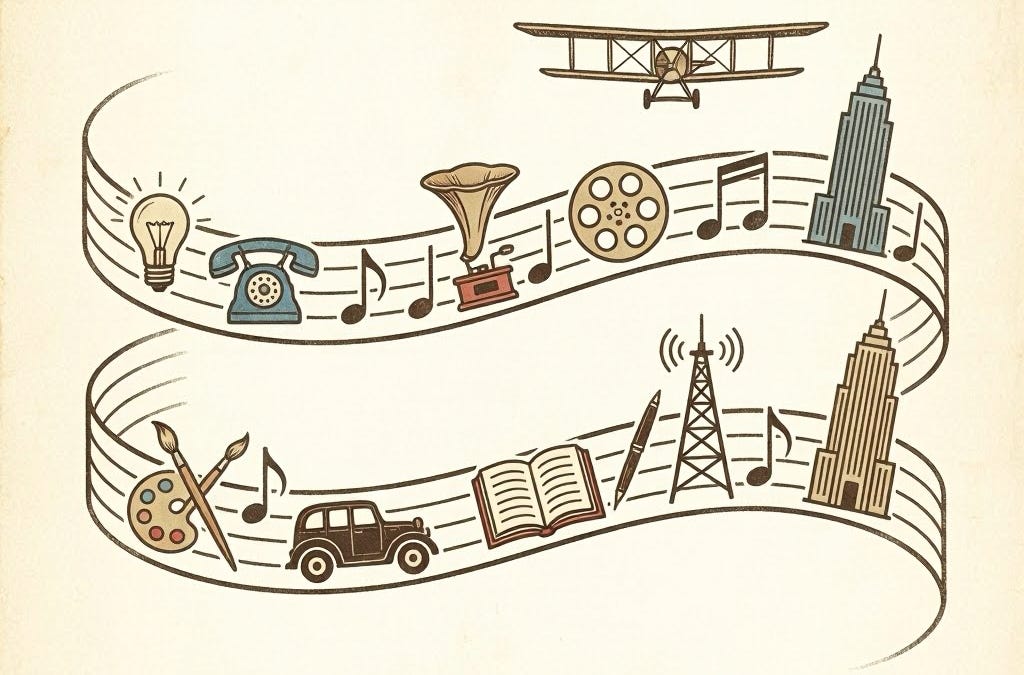
Creativity never ceases — but it intensifies when a culture is forced to rebuild. The period between 1870 and 1930 is the clearest example of this pattern in American history. After the Civil War, the country did not simply recover; it reinvented itself. That rebuilding created new industries, new jobs, new technologies, new cultural needs, and new psychological openings. It cleared space for creativity to surge.
The result was a Creative Flowering — a period of astonishing innovation across art, music, literature, technology, and metaphysics. It was the moment when America stepped onto the world stage not just as an industrial power, but as a creative civilization.
Rebuilding After the Civil War
The Civil War left the nation fractured, traumatized, and economically destabilized. Reconstruction attempted to repair the political and social fabric, but the deeper rebuilding happened in the decades that followed. America rebuilt itself through:
rapid industrialization
expansion of railroads
electrification
urban growth
immigration waves
new educational institutions
new scientific laboratories
new cultural centers
This rebuilding was not orderly. It was chaotic, uneven, and often painful. But it created new space — physical, economic, and psychological — for creativity to intensify.
Rebuilding is generative. It demands new solutions, new tools, new systems, new ways of thinking. It creates opportunity. And opportunity invites imagination.
New Industries, New Jobs, New Technologies
Between 1870 and 1930, America built the infrastructure of the modern world. The rebuilding produced:
factories
telegraph and telephone networks
electrical grids
railroads and subways
skyscrapers
universities and research labs
publishing houses
film studios
These were not incremental improvements. They were new realities.
The rebuilding created jobs that had never existed before:
electrical engineers
telephone operators
radio technicians
airplane mechanics
film directors
jazz musicians
modern painters
Entire professions emerged from the rebuilding process. Creativity surged because the culture suddenly needed new forms of expression, new technologies, new art, new music, new stories.
The Technological Breakthroughs of the First Flowering
The First Flowering produced inventions that permanently altered human life:
· electric light (Edison) — illumination that extended human activity beyond daylight
· telephone (Bell) — instantaneous voice communication across distance
· phonograph — the first technology to capture and replay sound
· motion pictures — a new medium for memory, storytelling, and imagination
· radio — mass communication and shared national experience
· airplane (Wright brothers) — the conquest of the sky and global mobility
· automobiles — personal mobility, reshaped cities, and transformed daily life
· typewriter — standardized writing, modern office work, and literary production
· elevators & steel-frame construction — the birth of skyscrapers and vertical cities
· electric power grids — the infrastructure that made modern life possible
These inventions did not simply improve communication or transportation. They changed consciousness. They expanded the sensory world. They altered how people experienced time, space, sound, and light.
Electric light extended the day. Radio extended the voice. Film extended memory. The airplane extended geography.
Technology became a new medium for imagination.
The Artistic Breakthroughs: Picasso, O’Keeffe, Hopper
While America rebuilt its physical infrastructure, the artistic world rebuilt its symbolic language.
Picasso
Picasso shattered the visual grammar of Western art. Cubism was not just a style — it was a new way of seeing. It reflected the fragmentation and reconstruction of the modern world.
Georgia O’Keeffe
O’Keeffe created a new American visual vocabulary — abstract, sensual, spacious, contemplative. Her work expressed the inner life of a culture in transition.
Edward Hopper
Hopper captured the psychological landscape of modernity — solitude, quiet, interiority, the tension between isolation and possibility.
These artists were responding to the same forces that shaped American technology: rebuilding, fragmentation, expansion, and the search for new meaning.
Louis Armstrong and the Birth of Jazz
If the First Flowering had a single musical emblem, it was Louis Armstrong.
Armstrong did not just play jazz — he transformed it. His phrasing, tone, improvisation, and rhythmic innovation created a new musical language. Jazz was the sound of a culture rebuilding itself:
improvisational
democratic
hybrid
expressive
forward‑moving
Jazz emerged from Black creativity — the engine of American cultural innovation. It was born from pressure, resilience, and imagination. It became the soundtrack of the First Flowering.
Why Creativity Intensified
Creativity intensified because rebuilding opened new space.
Rebuilding creates:
new problems
new tools
new industries
new audiences
new cultural needs
new psychological landscapes
When a culture rebuilds, it becomes porous. It becomes receptive. It becomes hungry for new forms. Creativity accelerates because the old structures no longer fit the new reality.
The First Flowering was not a random burst of genius. It was the natural consequence of rebuilding after a national trauma. It was the moment when America’s continuous creativity rose into a wave.
Alongside these new instruments of communication, a vast publishing industry was taking shape — rotary presses, linotype machines, and national distribution networks transforming print into one of the first truly mass‑circulation mediums. Newspapers, magazines, and inexpensive books carried ideas across the country with a speed and reach no earlier generation had known. Print became a cultural bloodstream, binding distant communities into a shared imaginative field and giving individual creators a pathway into collective awareness.
The First Flowering as Pattern
This period established the rhythm that would repeat in the 1960s:
restriction
pressure
rebuilding
metaphysical turn
creative flowering
This First Flowering was the first great demonstration of this cycle. It showed that creativity intensifies when a culture is forced to reinvent itself.
And it set the stage for a Second Flowering — which would follow the same pattern after another national trauma.