

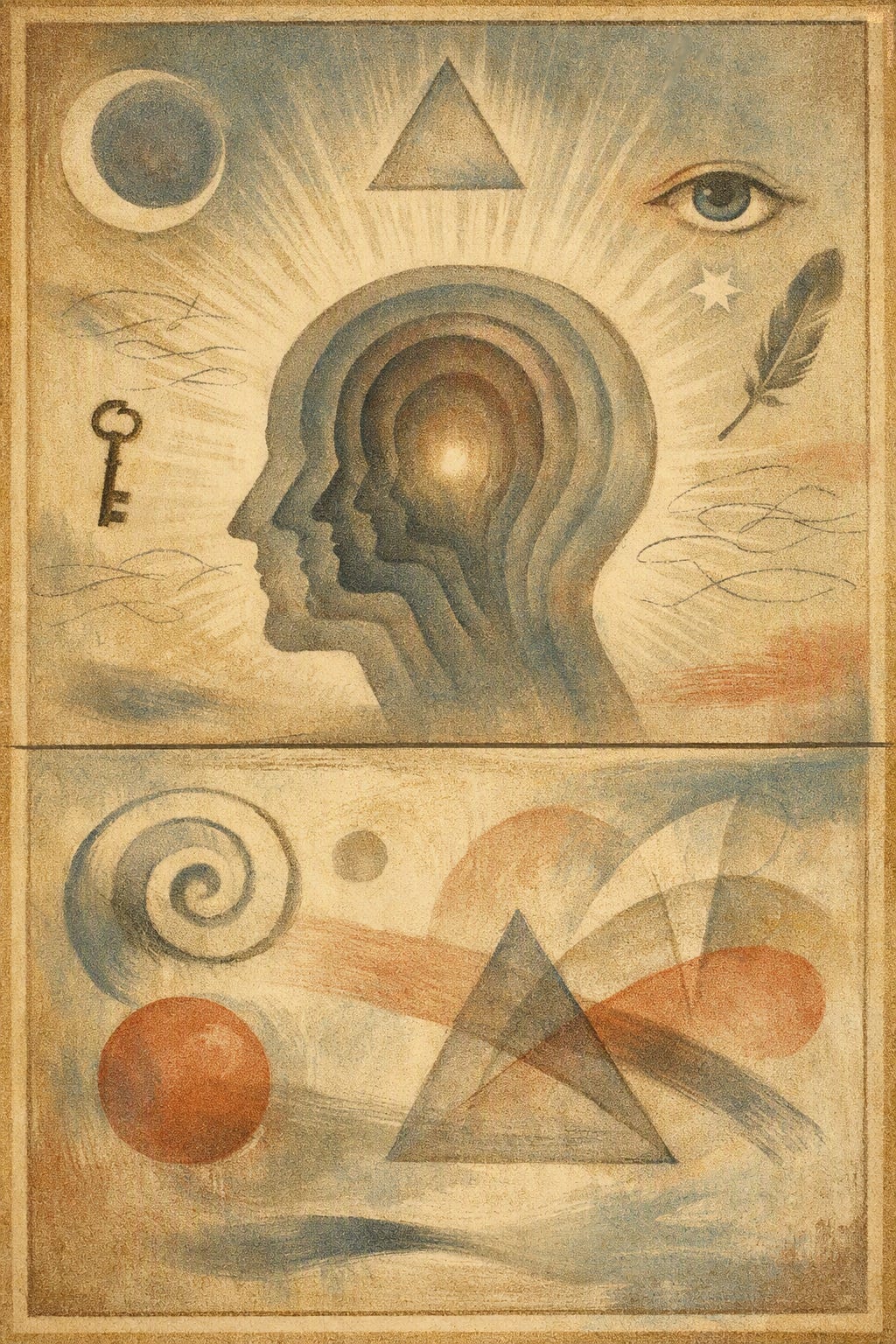
The First Flowering was not only technological and artistic — it was metaphysical. Beneath the inventions, the paintings, the music, and the literature was a profound cultural shift toward the unseen, the symbolic, and the spiritual. The period between 1870 and 1930 was saturated with metaphysical curiosity. It was a time when Americans were asking new questions about consciousness, identity, intuition, and the nature of reality.
This metaphysical imagination was not a fringe phenomenon. It was a cultural engine. It shaped modern art, modern psychology, and modern creativity itself.
Spiritualism: The First Metaphysical Wave
Spiritualism began in the 1840s and surged after the Civil War, when grief and trauma made the idea of communication with the dead emotionally compelling. Séances, mediums, automatic writing, and trance states became widespread.
Spiritualism contributed three essential elements to the First Flowering:
the legitimacy of altered states
the idea that consciousness has layers
the belief that symbolic messages can come from beyond ordinary awareness
These ideas would later influence psychology, art, and literature.
Theosophy: A Global Metaphysical System
Founded by Helena Blavatsky in 1875, Theosophy brought Eastern mysticism, esoteric symbolism, and occult philosophy into Western culture. It introduced:
reincarnation
karma
subtle bodies
cosmic evolution
sacred geometry
the unity of all religions
Theosophy profoundly influenced modern art. Kandinsky, Mondrian, and many American modernists drew directly from Theosophical ideas about abstraction, vibration, and spiritual form.
Theosophy gave artists permission to paint the invisible.
New Thought: Mind as Creative Force
New Thought emerged in the 1880s and argued that consciousness shapes reality. It emphasized:
mental causation
affirmation
metaphysical healing
the creative power of thought
the unity of mind and body
New Thought was the precursor to modern self‑help, but more importantly, it gave Americans a new model of inner agency. There were several inspiring authors associated with New Thought, including my favorites: Orison Swett Marden and Emmett Fox. Creativity became not just expression, but manifestation. The Law of Attraction originated with the New Thought movement.
This idea fed directly into the optimism and inventiveness of the First Flowering of Creativity.
Psychical Research: The Scientific Study of the Unseen
William James and other early psychologists took trance states, mediumship, mystical experience, and automatic writing seriously enough to study them scientifically. Psychical research explored:
telepathy
trance
dissociation
mystical union
subconscious creativity
This was not superstition — it was an attempt to map the unseen architecture of mind.
Psychical research gave intellectual legitimacy to metaphysical experience.
Freud: The Unconscious as a New Metaphysical Realm
Freud belongs here — not as a metaphysical advocate, but as a thinker who translated metaphysical questions into psychological language.
Freud’s work introduced:
the unconscious
dream symbolism
repression
hidden motives
the idea that inner life shapes outer behavior
Freud did not endorse Spiritualism or Theosophy, but he made it intellectually respectable to explore:
dreams
symbols
fantasies
childhood memories
inner conflict
the unseen forces shaping creativity
Freud gave artists and writers a new vocabulary for the invisible.
His influence on modern literature (Joyce, Woolf, Proust) and modern art (surrealism, expressionism) was enormous. Freud helped shift the cultural imagination inward — exactly the direction metaphysical movements were already pointing.
Early Psychology: Trance, Automatic Writing, Mystical States
Early psychologists were fascinated by:
hypnosis
trance
dissociation
mystical experience
automatic writing
altered states of consciousness
These phenomena were studied not as curiosities, but as windows into the deeper layers of mind.
This fascination created a bridge between metaphysics and science — a bridge that artists crossed eagerly.
How Metaphysical Curiosity Shaped Modern Art and Literature
The metaphysical imagination of 1870–1930 shaped modern creativity in three major ways:
1. Abstraction
Artists began to paint not objects, but states of consciousness. Kandinsky’s “inner necessity” and O’Keeffe’s symbolic forms emerged from metaphysical ideas about vibration, essence, and inner reality.
2. Symbolism
Writers and poets used myth, dream, and archetype to explore the psyche. Modern literature became introspective, layered, and symbolic.
3. Experimentation
Metaphysical curiosity encouraged artists to break old forms. Cubism, surrealism, jazz improvisation, and modern dance all emerged from the belief that reality has multiple dimensions.
The metaphysical imagination made creativity bolder.
Why Metaphysics Always Rises During Rebuilding
Whenever a culture rebuilds, outer structures become unstable. People turn inward for meaning, identity, and coherence. Metaphysics rises because:
the old symbolic systems no longer fit
the psyche seeks new forms
trauma opens inner questions
rebuilding creates psychological space
creativity needs new metaphors
Metaphysics is not escapism. It is preparation.
It gives artists, inventors, and thinkers the symbolic tools they need to create new worlds.
The Metaphysical Engine of the First Flowering
The First Flowering was not only technological and artistic — it was spiritual. The metaphysical imagination provided:
new symbolic languages
new models of consciousness
new ways of seeing
new ways of creating
new ways of understanding the self
It was the inner engine of the creative explosion.
And it established the pattern that would repeat in the 1960s — and again in the emerging Third Flowering.
Next Week: PART IV
So fabulous Jim and I so relate. You are a wonderful writer!!!