


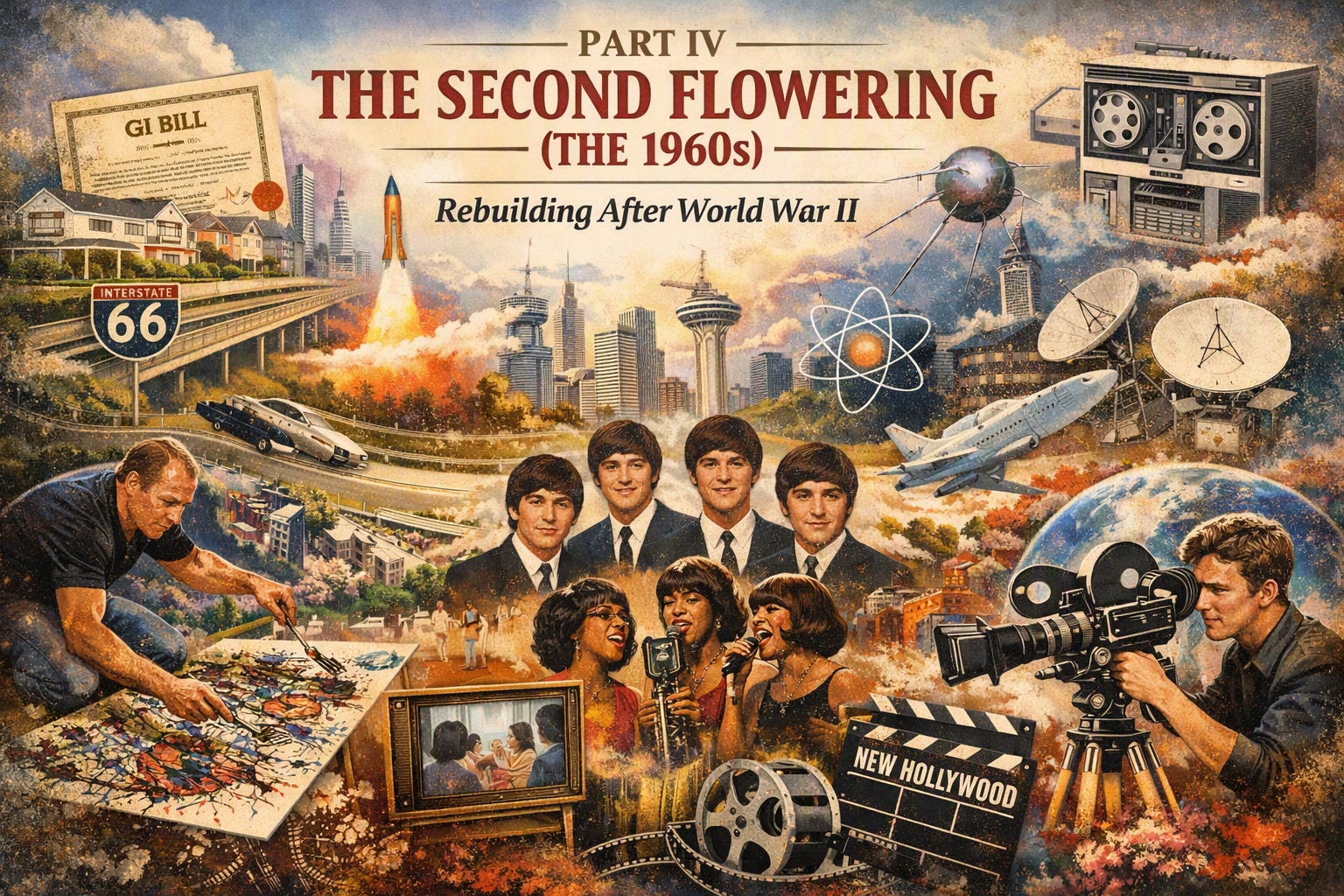
The Second Flowering did not arise from stability — it arose from rebuilding. Following the Great Depression and World War II, America entered a period of massive reconstruction. The nation rebuilt its economy, its infrastructure, its educational systems, its technological base, and its cultural identity. This rebuilding created new industries, new jobs, new technologies, new cultural needs, and new psychological openings.
And once again, creativity surged.
The 1960s were not an isolated burst of genius. They were the natural consequence of rebuilding after a national trauma — the same pattern that produced the First Flowering. But this time, the rebuilding was global, technological, and psychological. It reshaped the entire landscape of American life.
Rebuilding After World War II
The postwar rebuilding was vast. It touched every part of American society:
The GI Bill sent millions to college, creating a new intellectual class.
Suburbanization reshaped geography and daily life.
Cold War infrastructure poured money into science, engineering, and aerospace.
Aerospace industries emerged from wartime research and accelerated innovation.
Early computing began in military labs and university research centers.
New universities and research institutions expanded the scientific imagination.
This rebuilding was not merely economic — it was psychological. It created a sense of possibility, expansion, and forward motion. It opened space for creativity to intensify.
New Industries, New Jobs, New Technologies
The rebuilding produced technologies that permanently altered human consciousness:
television
interstate highways
atomic energy
integrated circuits
early computers
jet travel
satellites
These were not incremental improvements. They were new realities.
Television changed how people saw the world. Highways changed how people moved through it. Atomic energy changed how people imagined power. Integrated circuits changed how people thought about information. Jet travel changed the scale of geography. Satellites changed the scale of communication.
Technology became a new dimension of experience.
The Artistic Breakthroughs: Pollock, New Hollywood, and the Beatles
While America rebuilt its physical and technological infrastructure, artists rebuilt its symbolic language.
Jackson Pollock
Pollock shattered the boundaries of painting. His work was not representation — it was energy, gesture, movement, psyche. Pollock painted the inner life of a culture undergoing transformation.
New Hollywood
Filmmakers like Kubrick, Coppola, and Scorsese reinvented cinema. They brought psychological depth, symbolic complexity, and mythic storytelling into mainstream film.
The Beatles
The Beatles transformed music into a global symbolic language. Their work fused innovation, emotion, experimentation, and metaphysical curiosity. They became the emblem of the Second Flowering.
These artists were responding to the same forces that shaped postwar technology: rebuilding, expansion, acceleration, and the search for new meaning.
Black Creativity as the Cultural Engine
As in the First Flowering, Black creativity was the engine of the Second Flowering. It produced the musical forms that defined the era:
soul
R&B
Motown
funk
jazz innovation
gospel‑infused rock
Black creativity provided:
the emotional vocabulary
the rhythmic foundation
the expressive intensity
the spiritual depth
the cultural energy
that powered the entire flowering.
Without Black creativity, the Second Flowering would not have existed.
Rock, Folk, and Electronic Advances
The musical frontier expanded in every direction:
rock became mythic and symbolic.
folk became political and poetic.
electronic music opened new sonic dimensions.
psychedelic music explored altered states of consciousness.
jazz pushed into modal, free, and avant‑garde territories.
Music became a laboratory for consciousness.
Why Creativity Intensified
Creativity intensified because rebuilding opened new space.
Rebuilding creates:
new problems
new tools
new industries
new audiences
new cultural needs
new psychological landscapes
The postwar rebuilding created a culture that was porous, receptive, and hungry for new forms. The old structures no longer fit the new reality. Creativity accelerated because the nation was reinventing itself.
The Second Flowering was not a random burst of genius. It was the natural consequence of rebuilding after a global trauma. It was the moment when America’s continuous creativity rose into a wave — again.
The Second Flowering as Pattern
The Second Flowering repeated the rhythm of the First:
restriction
pressure
rebuilding
metaphysical turn
creative flowering
It demonstrated that creativity intensifies when a culture is forced to rebuild. And it set the stage for the Third Flowering — which will follow the same pattern, but on a larger scale.