

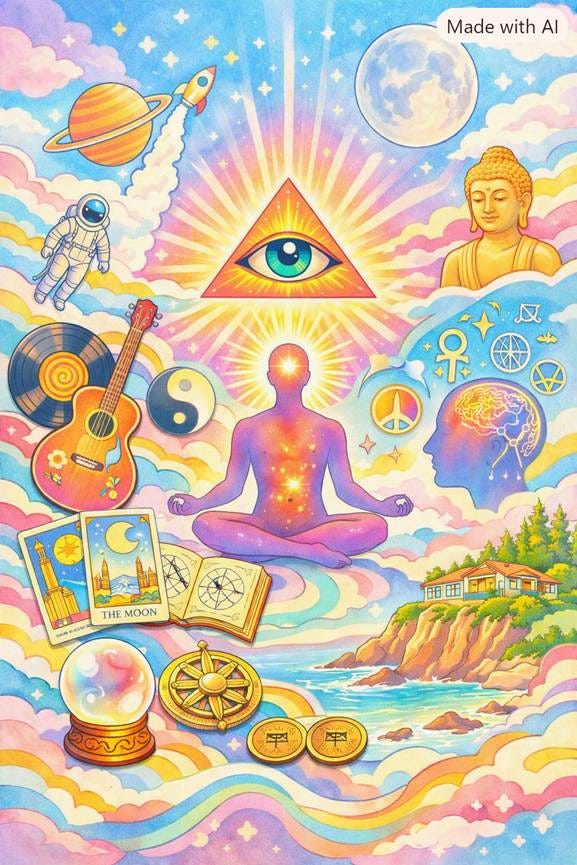
If the 1960s rebuilt the outer world — highways, satellites, computers, suburbs — they also rebuilt the inner world. The Second Flowering was not only technological and artistic. It was metaphysical. It was a cultural awakening to consciousness itself.
The 1960s were the moment when Americans realized that the frontier was not just space, or science, or technology — the frontier was the mind.
And once again, metaphysical curiosity fueled creative intensity.
Psychedelic Mysticism and Altered States
Psychedelics did not create the 1960s. They revealed the 1960s.
They opened:
new perceptual dimensions
new symbolic languages
new emotional intensities
new spiritual questions
new artistic possibilities
Psychedelics made consciousness visible. They made the inner world feel as vast as the outer world. They dissolved boundaries — between self and other, between art and life, between science and spirit.
This was not escapism. It was exploration.
The psychedelic movement was the metaphysical counterpart to the space race. NASA explored outer space. Psychedelia explored inner space.
Both were expressions of the same cultural energy: expansion.
Meditation, Yoga, and Eastern Spirituality
As psychedelics opened the door, Eastern traditions walked through it.
Meditation, yoga, Zen, Vedanta, and Tibetan practices entered American culture not as exotic imports but as tools for consciousness.
They offered:
stillness
attention
breath
presence
non‑attachment
compassion
inner clarity
These practices provided what psychedelics could not: stability.
They gave people a way to explore consciousness without dissolving into it.
Eastern spirituality became the grounding mechanism for the metaphysical imagination — the way to integrate altered states into daily life.
Jungian Archetypes Entering Popular Culture
Jung’s ideas — once confined to psychology — exploded into the cultural mainstream.
People began talking about:
archetypes
synchronicity
the collective unconscious
shadow work
symbolic dreams
mythic patterns
Jung provided a language for the inner world that was:
symbolic
universal
non‑dogmatic
psychologically grounded
spiritually resonant
Jungian thought gave the 1960s a mythic vocabulary — a way to understand personal experience as part of a larger symbolic pattern.
This was crucial. It gave the metaphysical imagination structure.
Esalen and the Human Potential Movement
Esalen Institute became the epicenter of the inner frontier.
It brought together:
psychologists
mystics
philosophers
artists
scientists
spiritual teachers
bodyworkers
consciousness explorers
Esalen was the laboratory where the metaphysical imagination was tested, refined, and expanded.
The Human Potential Movement emerged from this crucible. It proposed a radical idea:
**Human beings are not finished.
We are still evolving. Consciousness is the next stage.**
This idea electrified the culture. It gave the metaphysical imagination a purpose.
Tarot, Astrology, and the Occult Revival
As consciousness expanded, symbolic systems returned.
Tarot, astrology, I Ching, Kabbalah, and occult traditions re‑entered the cultural conversation — not as superstition, but as symbolic maps.
People used them to explore:
intuition
archetypes
synchronicity
personal myth
inner guidance
These systems provided structure for the metaphysical imagination — ways to navigate the inner world without getting lost.
They were not literal beliefs. They were symbolic tools.
Music as Metaphysical Awakening
Music became the primary vehicle for metaphysical experience.
Rock, folk, jazz, soul, and electronic music all carried metaphysical themes:
transcendence
unity
cosmic awareness
inner journey
symbolic storytelling
altered states
spiritual longing
The Beatles, Coltrane, Hendrix, Dylan, and countless others turned music into a consciousness technology.
Music became the sound of awakening.
It was the emotional engine of the metaphysical imagination.
Why Metaphysical Curiosity Fueled Creative Intensity
Because metaphysical curiosity expands the inner world.
Creativity requires:
openness
imagination
symbolic thinking
emotional depth
psychological risk
spiritual hunger
The metaphysical imagination provided all of these.
It gave artists new tools, new questions, new symbols, new experiences, new emotional intensities, and new ways of seeing reality.
The Second Flowering was not just technological. It was metaphysical.
Creativity surged because consciousness surged.
The Pattern Reappears
Just as in the First Flowering (1870–1930):
new technologies
new invisible forces
new cultural pressures
new psychological openings
led to:
spiritual exploration
metaphysical curiosity
symbolic experimentation
artistic breakthroughs
The pattern repeated.
Rebuilding → Expansion → Invisible forces → Metaphysical imagination → Creative flowering.
The 1960s were the second great wave of this pattern.
And they set the stage for the Third Flowering — the one we are entering now.