

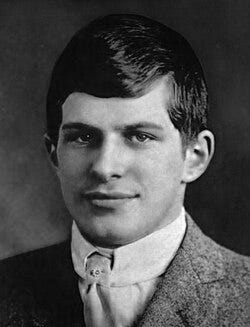
In the early years of the twentieth century, a young man named William James Sidis became one of the most celebrated child prodigies in America.
His father, Boris Sidis, was an acclaimed psychologist who believed that human intelligence could be dramatically developed through carefully designed educational methods. He and his wife devoted themselves to cultivating their son’s extraordinary mind.
By conventional measures, their experiment succeeded.
The young Sidis astonished the public with his intellectual abilities. In 1909, at age 11, Sidis set a record by becoming the youngest person to enroll at Harvard University. The next year, Sidis’ mastery of higher mathematics was such that he lectured the Harvard Mathematical Club on four-dimensional bodies, attracting nationwide attention. Newspapers portrayed him as a glimpse of humanity’s future. If intelligence could be engineered, perhaps he represented the next step in human evolution.
Yet the story took an unexpected downward turn.
As an adult, Sidis retreated from public life. He was inapt socially and sought anonymity rather than fame. The brilliance that had captivated the nation did not bring him happiness. Instead, his life became a cautionary tale about the difference between intelligence and human flourishing.
In 1944, William James Sidis died alone in a small rented room in Boston from a cerebral hemorrhage. He was only forty-six years old.
Today, as we race to create increasingly intelligent machines, the story of Sidis invites a moment of reflection. What happens when intelligence becomes the primary measure of success? What other dimensions of life are overlooked when one variable is optimized above all others?
The lesson is not that intelligence is bad. The lesson is that intelligence alone is not enough.
Today, more than a century later, we find ourselves conducting a different experiment.
Its name is Artificial Intelligence. AI.
We celebrate every breakthrough. We measure benchmark scores. We compare models. We marvel at new capabilities. Once again society is captivated by increasingly powerful forms of intelligence.
And once again we may be asking the wrong question.
The central question is not: How intelligent can we make a machine? The central question is: What kind of human beings will we become in the presence of such machines?
The Sidis experiment produced exactly what it was designed to produce. The surprise was that success exposed weaknesses in the original design.
The designers had optimized for intellect. They had not optimized for a whole life.
Something similar could happen with AI.
Suppose we create systems that can write, analyze, calculate, diagnose, and create better than any human being. Then what? Will people become wiser? More curious? More compassionate? More resilient?
Those outcomes do not automatically follow from increased intelligence.
The psychologist William James observed that wisdom is often found not merely in thought but in experience, action, and attention. Some of the most important dimensions of life cannot be measured by IQ tests or computational benchmarks.
Character. Meaning. Purpose. Love. Beauty. Friendship.
The capacity to sit quietly and listen.
These qualities may prove to be every bit as important in the age of AI as they were in the age of William Sidis.
Thought alone is not enough. An idea must be embodied in action before it becomes part of a life.
Perhaps the same principle applies to artificial intelligence.
Intelligence by itself is not the destination. It is only one ingredient. The real challenge lies in what we do with it.
The tragedy of William Sidis was not that he became intelligent. The tragedy was that intelligence became the story.
As we enter the age of AI, we should remember that human beings are larger than their intellectual capacities.
William Sidis reminds us that the goal is not to produce the greatest possible intelligence.
The goal is to help intelligence find its proper place within a whole human life.
Human beings did not become the dominant species because we were the strongest, fastest, or even the smartest individual creatures. We prevailed because we learned to cooperate. The lesson of William James Sidis is that intelligence alone does not guarantee human flourishing. The lesson of AI may be the same. Our future will depend not on creating ever-greater intelligence, but on strengthening the communities within which intelligence serves human life.
The lesson of William James Sidis may be that intelligence is not the highest human achievement. Intelligence is a gift, but it reaches its fullest expression only within a balanced life and a healthy community. As we develop increasingly capable artificial intelligence, we should remember that humanity’s greatest strength was never the brilliance of a single mind. It was our ability to learn from one another, care for one another, and build communities in which knowledge serves human flourishing.
The future will not be determined by what our machines can think.
It will be determined by what we choose to value.