

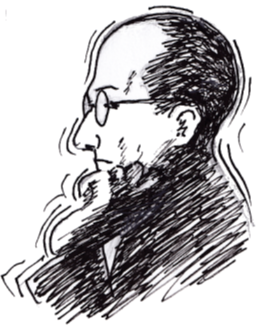
Piet Mondrian (1872 – 1944)
Mondrian was a mystic and visionary artist who revolutionized the way we perceive art and its connection to the spiritual realm. Born in the Netherlands, Mondrian played a pivotal role in the development of abstract art, leading to a profound transformation in our vision of the world. Through his iconic geometric compositions, Mondrian offered us a glimpse into the divine order and harmony that lie beneath the surface of reality.
Mondrian’s journey toward becoming a visionary artist began with his initial exploration of naturalistic landscapes and traditional painting techniques. However, it was his encounter with Theosophy, a mystical movement that seeks to understand the nature of divinity, that deeply influenced his artistic style and spiritual beliefs. Embracing theosophical ideas such as the interconnectedness of all things and the existence of a higher spiritual realm, Mondrian’s art underwent a dramatic shift.
One of Mondrian’s most groundbreaking contributions was his role in the creation of a new art movement which he called neoplasticism. He was also instrument in organizing a group of artists who called themselves De Stijl, which rejected the representation of recognizable objects and instead focused on the fundamental elements of art, such as line, shape, and color. Mondrian believed that through simplification and abstraction, he could uncover the underlying spiritual energy that vibrates within all things. His compositions consisted of grids and primary colors, meticulously arranged to create a sense of harmony and balance.
The spirituality embedded within Mondrian’s art was not limited to the content of his works; it extended to the process of creation itself. He described his artistic practice as a meditative process, a way to connect with the divine forces that governed the universe. By removing all unnecessary elements from his compositions, Mondrian aimed to distill the essence of spiritual truth and purity. In his own words, he sought to “express the plastic expression of the spirit of our time.”
The impact of Mondrian’s vision on the art world and beyond cannot be overstated. His bold departure from traditional representation and his emphasis on abstraction as a means of revealing the spiritual world opened the doors for countless artists to explore new artistic possibilities. From the abstract expressionists of the mid-20th century to contemporary artists pushing the boundaries of technology and digital art, Mondrian’s influence persists.
Mondrian believed his abstraction could serve as a universal pictorial language representing the dynamic, evolutionary forces that govern nature and human experience. In fact, he believed that abstraction provides a truer picture of reality than illusionistic depictions of objects in the visible world.
Moreover, Mondrian’s work invites viewers to question their own perception of reality and the inherent spirituality within it. By unveiling the underlying order and harmony through his compositions, he challenges us to see beyond the surface and connect with the profound spiritual dimensions present in our lives. In this sense, Mondrian’s art is not only a visual experience but also a spiritual one, allowing us to transcend the limitations of our physical world and glimpse the sublime.
Mondrian’s status as a mystic and visionary artist is indisputable. Through his pioneering approach to art, he changed our vision by revealing the profound spiritual energies hidden within the world. From his development of neoplasticism to his meditative artistic practice, Mondrian’s work has left an indelible mark on the art world, inspiring countless artists to explore the realm of abstraction and spirituality. As long as his iconic compositions continue to captivate and challenge our perception, Mondrian’s legacy as a visionary artist will endure.
Hilma af Klint (1862 – 1944)

Hilma af Klimt was a remarkable female artist of the early 20th century. She stands as a visionary and mystic whose work transcended conventional artistic boundaries – especially the social boundaries imposed on women during her lifetime. Often regarded as a pioneer of abstract art, af Klint’s paintings were imbued with spiritual and esoteric symbolism, reflecting her deep engagement with Theosophy and spiritual exploration. Despite creating a vast body of work, af Klint’s genius remained hidden for decades, only to be rediscovered in recent years, sparking renewed fascination and appreciation for her art.
Af Klint’s early influences were mainly rooted in the prevailing artistic trends of the late 19th century, but her inquisitive mind sought something beyond mere representation. It was later in her career that her artistic path took a remarkable turn towards the realm of mysticism.
Around 1896, she began to question the limitations of the visible world and delved into exploring the metaphysical realm. This shift marked the beginning of a lifelong spiritual and artistic quest, setting her apart from the conventional art scene of her time.
Af Klint’s exploration of spirituality led her to the teachings of Theosophy. Theosophy opened her mind to the interconnectedness of all things and the possibility of transcending ordinary reality. This encounter sparked an intense fascination with symbolism and esoteric knowledge, which would become the foundation of her artistic philosophy.
Fueling her spiritual journey, af Klint immersed herself in various spiritual practices, including séances and automatic writing. Through these practices, she sought direct communication with higher realms, receiving guidance and inspiration for her artistic creations. This unique blend of mysticism and artistry became the cornerstone of her innovative approach to painting.
Klint’s artistic style underwent a radical transformation as she delved deeper into the realm of spirituality. Breaking free from the constraints of traditional representation, she ventured into abstraction, foreshadow-ing the abstract art movement that would later take the art world by storm. Her paintings became gateways to other dimensions, evoking emotions and experiences beyond the tangible.
In her quest to represent the spiritual realm, Klint developed a unique visual language that combined geometric and organic forms. Her paintings featured symmetrical shapes, spirals, and intricate patterns, reflecting the interconnectedness of the spiritual and natural worlds. Klint’s fusion of these elements created a mesmerizing visual tapestry that continues to captivate audiences today.
In Klint’s paintings, symbols served as gateways to deeper layers of meaning. Circles represented unity and eternity, while spirals embodied evolution and growth. Colors were chosen deliberately, with each hue carrying symbolic weight. Klint’s works invited viewers to embark on their own journeys of interpretation, unlocking personal connections through the universal language of symbolism.
Despite the profound nature of her art, Hilma af Klint faced significant challenges in gaining recognition during her lifetime. The abstract, spiritually-driven nature of her work was ahead of its time and did not conform to the established artistic conventions of her era. Consequently, her art received little attention and remained largely unknown outside of a small circle.
The pictures were painted directly through me, without any preliminary drawings, and with great force. I had no idea what the paintings were supposed to depict; nevertheless, I worked swiftly and surely, without changing a single brush stroke.
My mission, if it succeeds, is of great significance to humankind. For I am able to describe the path of the soul from the beginning of the spectacle of life to its end.
― Hilma af Klint
It wasn’t until decades after her death that Hilma af Klint’s extraordinary talent and unique artistic vision began to receive the recognition it deserved. In the late 1980s, her hidden collection of over 1,000 paintings was discovered, shedding new light on her artistic genius. Since then, her work has been showcased in major exhibitions worldwide, garnering critical acclaim and captivating audiences with its spiritual depth and originality.
Hilma af Klint stipulated in her will that her abstract paintings should not be displayed until 20 years after her death. This, combined with the fact that her visionary approach to art was ahead of its time, led to her work remaining relatively unknown and hidden from the public eye for several decades. It was not until 1964 (20 years after her death) that af Klint’s art began to be rediscovered and appreciated.
This is an excerpt from The New Infinite Vision by Bennecelli (James Bennett), available HERE.